
How Much Does Custom Software Development Cost?
One of the first questions businesses ask when considering custom software is simple: How much will it cost? The answer is not a single number. Custom software development can range from a relatively focused application built for a specific business process to a large, complex platform involving multiple users, integrations, dashboards, databases, and advanced functionality. The final cost depends on what the software needs to do, how complex the requirements are, who will use it, which systems it needs to connect with, and how it will be maintained after launch.
This is why two businesses can ask for “custom software” and receive completely different estimates. A small internal application with a few screens and basic functionality requires a very different amount of planning and development compared with a complete business management platform used by multiple departments. For businesses considering custom software, understanding what influences the cost is more useful than looking for a fixed price. It helps you define your requirements, compare proposals, prioritize features, and understand where your investment is going.
What Is Custom Software Development?
Custom software development means creating software specifically around the requirements of a business, organization, or particular group of users. Instead of adapting business processes to an existing software product, custom software is designed to support the processes the business actually follows.
For example, a company may need a system to manage customers, quotations, orders, internal approvals, service requests, documents, payments, inventory, or several of these processes together. If available software does not adequately support those requirements, a customized solution may be considered.
Custom software can take many forms. It could be a web application, internal management system, customer portal, business dashboard, industry-specific platform, or a customized CRM. The cost therefore depends heavily on the type of software being developed and the requirements behind it.
Is There a Fixed Cost for Custom Software?
There is no universal fixed cost for custom software development because every project has different requirements. A simple application with limited functionality may require considerably less development work than a platform with multiple user roles, complex business rules, integrations, reporting, and advanced security requirements. Giving a fixed price before understanding the requirements can therefore be misleading.
A proper estimate usually comes after understanding the business problem, documenting the required functionality, identifying the users, reviewing integrations, and determining the technical scope. This is why businesses should be cautious about comparing software development companies based only on an initial price. Two proposals may appear very different because they include different assumptions about functionality, design, testing, integrations, support, and future development. The more clearly the project is defined, the more meaningful the cost estimate becomes.
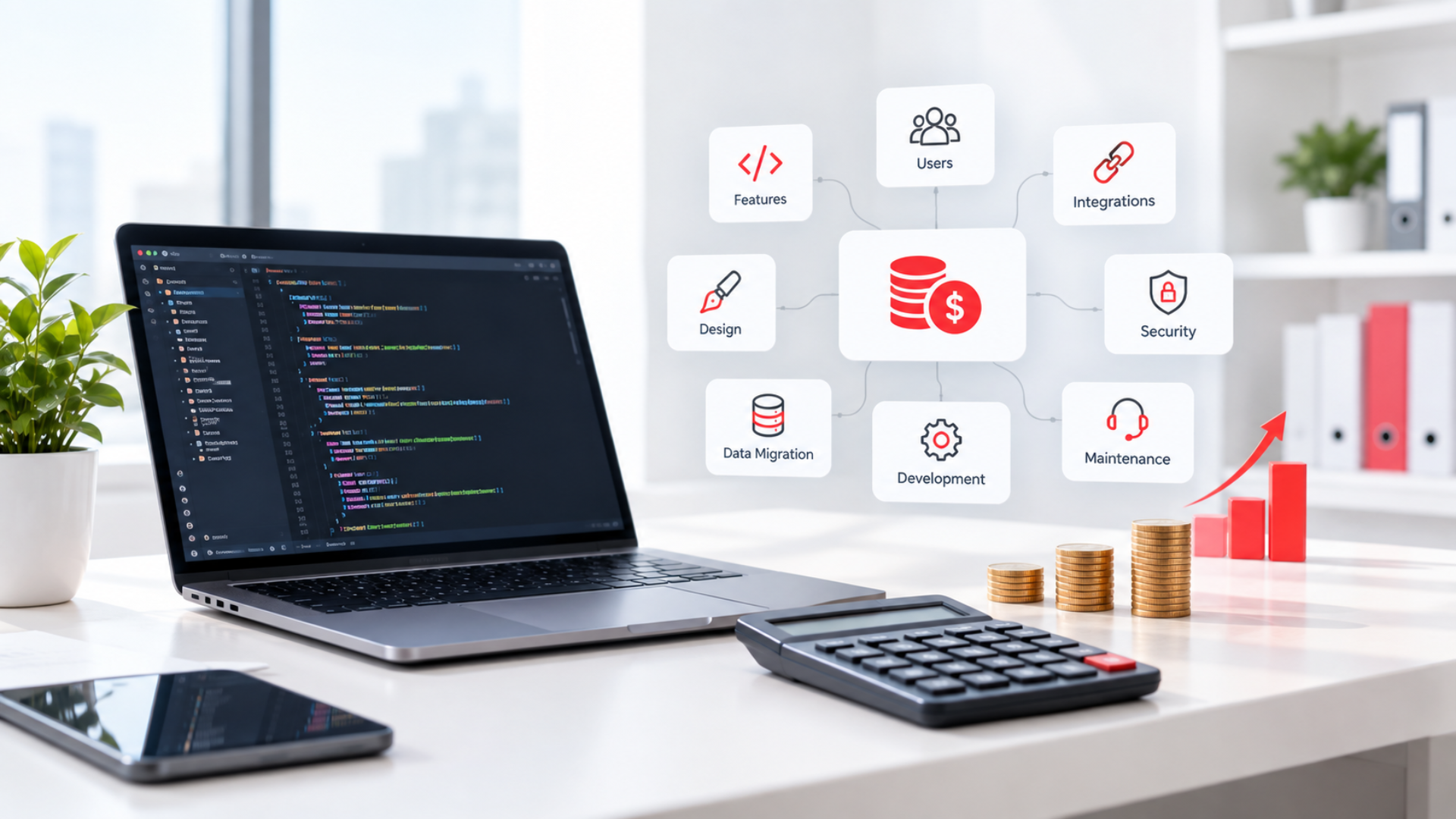
What Determines the Cost of Custom Software Development?
Several factors influence the overall development cost. Understanding these factors can help businesses plan their software investment more realistically.
1. Software Complexity
The complexity of the software is one of the biggest factors affecting development effort. A straightforward application may contain a limited number of screens, users, and business rules. A more complex system may involve multiple departments, complicated workflows, permissions, calculations, dashboards, integrations, notifications, and different types of users.
For example, a simple customer information system may have basic customer records and search functionality. A larger business management system could include customer management, sales processes, quotations, orders, invoices, reports, user permissions, notifications, and integrations. The second project requires considerably more planning, development, testing, and maintenance.
2. Number of Features
Every feature adds to the scope of a software project. Features could include user registration, dashboards, search, filtering, document management, notifications, payment processing, reporting, approval systems, customer portals, scheduling, or other business functions.
This does not mean that businesses should remove useful features simply to reduce cost. Instead, features should be prioritized according to their business value. A good approach is to separate the requirements into essential features and features that can be introduced later. This allows the first version of the software to focus on the most important business requirements while leaving room for future development.
3. Number of Users and User Roles
A system designed for one type of user can be simpler than a system that supports several departments with different permissions. For example, an internal application might have employees and administrators. A larger platform may have administrators, managers, sales teams, operations teams, customers, vendors, and other user types. Each role may need different access, screens, actions, and permissions. The more complex the user structure becomes, the more planning and development may be required.
4. User Interface and User Experience
Software needs to be functional, but it also needs to be usable. The design requirements can influence the development effort. A simple internal application may require a straightforward interface, while a customer-facing platform may need a more carefully designed experience across different devices and user journeys. The project may involve interface design, responsive layouts, navigation, forms, dashboards, accessibility considerations, and usability testing. Businesses should therefore consider design as part of the software investment rather than treating it as something that can always be added later.
5. Integrations With Other Systems
Many businesses already use multiple software systems. Custom software may need to communicate with a CRM, accounting platform, payment gateway, ecommerce platform, website, database, communication service, or another business application. These integrations can significantly affect project scope.
The development team needs to understand what information needs to move between systems, how the systems communicate, what authentication is required, and how errors should be handled. Some integrations may be relatively straightforward, while others may require more complex custom development. This is one reason it is important to identify integrations during the requirements stage rather than adding them unexpectedly near the end of development.
6. Data Migration
Businesses replacing an existing system may need to move historical information into the new software. This could include customers, products, orders, documents, transactions, or other business records. Data migration is not always as simple as exporting information from one system and importing it into another. Different systems may use different data structures, field names, formats, or rules.
The data may also contain duplicates, incomplete records, or outdated information. If migration is part of the project, the development team may need to assess the existing data, clean or transform it, map fields, test the migration, and verify the results. This work can add to the overall project scope and should be considered when estimating cost.
7. Custom Business Logic
Some businesses have processes that are unique to the way they operate. For example, a company may have specific approval rules, pricing calculations, quotation processes, customer classifications, order conditions, or internal workflows. The more customized the business logic becomes, the more development and testing may be required. This is one of the key differences between buying standard software and developing a custom solution. Standard software generally works according to predefined functionality. Custom software can be designed around the specific rules and processes of the business.
8. Security Requirements
Security should be considered from the beginning of a software project. The requirements may include user authentication, access controls, password management, data protection, activity logs, secure communication, backups, and other security measures depending on the nature of the software. A system handling sensitive business or customer information may require more extensive security considerations than a simple internal tool. Security requirements should therefore be discussed during planning rather than treated as an optional addition after development.
9. Reporting and Dashboards
Businesses often want software to provide visibility into their operations. This may involve dashboards, reports, filters, charts, summaries, exports, or management views. Basic reporting may be relatively straightforward, while complex reporting can require additional data structures and business logic.
For example, a business may want managers to view sales performance by employee, location, product, period, or customer category. If the system needs to calculate and display this information dynamically, those requirements need to be considered during development.
10. Mobile and Responsive Requirements
Businesses should also decide how users will access the software. A web application may need to work across desktop computers, tablets, and mobile devices. Some businesses may require a dedicated mobile application depending on how employees or customers use the system. Building for different devices can affect the design, development, testing, and maintenance requirements. The correct choice depends on the users and the business process rather than simply choosing mobile development because it is available.
Custom Software Development Cost Is Also Affected by the Development Approach
Another factor is how the project is planned and delivered. Some businesses try to build every planned feature before releasing the software. Others start with a focused first version and expand the system based on actual usage and feedback. A phased approach can make it easier to prioritize the most important functionality.
For example, the first version might include customer management, user accounts, core workflows, and essential reporting. Additional integrations, advanced dashboards, or other features can be introduced later. This approach can help businesses manage scope and learn from real users before investing heavily in additional functionality.
Why Software Requirements Matter So Much
The quality of the requirements can have a major impact on the project. If requirements are unclear, the development team may have to make assumptions. As the project progresses, the business may discover that certain functions were not included or that the system needs to work differently. Changes during development can increase both time and cost.
This does not mean requirements can never change. Business needs can evolve, and new information can emerge during development. However, clearly documenting the initial requirements gives everyone a stronger foundation. Before requesting a software estimate, businesses should have a clear understanding of the problem they are trying to solve, the users involved, the required features, the systems that need to be connected, and the expected outcome.
How to Reduce Unnecessary Software Development Costs
Reducing cost does not necessarily mean choosing the cheapest development option. A better approach is to control unnecessary complexity. Start with the business problem and prioritize the functionality that directly addresses it. Avoid adding features simply because they sound impressive. Every additional feature can introduce development, testing, maintenance, and support requirements. It is also useful to identify integrations early, define user roles clearly, and document requirements before development begins. A phased development approach can also help. Instead of trying to build everything at once, businesses can identify the essential functionality for the initial version and plan future improvements separately. This allows the investment to remain connected to actual business needs.
Custom Software vs Off-the-Shelf Software
Cost is often one of the reasons businesses compare custom software with ready-made solutions. Off-the-shelf software can be more suitable when a business has common requirements that are already supported by an existing platform. Custom software becomes more relevant when the business has specialized processes, unique requirements, complex integrations, or operational needs that standard software does not handle effectively. The decision should therefore not be based only on the initial purchase price.
Businesses should also consider customization, implementation, integration, training, support, ongoing subscription costs, data migration, and how well the software will fit their processes over time. A cheaper software product may become expensive if employees have to constantly work around its limitations or use additional tools to fill the gaps. Similarly, custom development may not be necessary if an existing solution already meets the important requirements. The right decision depends on the specific business case.
Why the Cheapest Software Development Quote Is Not Always the Best Option
When comparing development proposals, businesses often look first at the total price. Price is important, but it should not be the only factor. A lower quote may be based on a smaller scope, fewer included features, limited testing, different technology assumptions, or less support after launch.
Businesses should compare what each proposal actually includes. Look at the development scope, functionality, integrations, design, testing, deployment, documentation, support, maintenance, and future changes. A clear proposal makes it easier to understand what you are paying for. The objective should be to find a development approach that provides the right balance between cost, quality, functionality, scalability, and long-term business value.
What Should Businesses Ask Before Starting a Custom Software Project?
Before starting development, businesses should be able to answer several important questions.
- What business problem are we solving?
The software should have a clear purpose.
- Who will use the system?
Different users may have different requirements and permissions.
- What are the essential features?
Not every possible feature needs to be included in the first version.
- Which systems need to be integrated?
Existing software and data sources should be identified early.
- What information needs to be stored and managed?
This helps define the database and data structure requirements.
- How will the software need to scale?
Consider future users, customers, transactions, locations, and functionality.
- What level of security is required?
The answer depends on the type of information and users involved.
- What happens after launch?
Maintenance, updates, support, hosting, security, and future development should all be considered.
Answering these questions gives both the business and the development team a much clearer starting point.
How Twister Automation Approaches Custom Software Projects
Twister Automation works with businesses on software consulting, CRM development, CRM implementation, integrations, and customized technology solutions. The focus is not simply on developing software with a list of features. The software needs to make sense within the business process it is designed to support. That means understanding the current process, identifying the problems, defining the requirements, and determining which technology approach is appropriate.
Depending on the business, the right solution may involve customizing an existing platform, integrating different systems, improving an existing CRM, or developing a more tailored software solution. Twister’s software consulting approach allows businesses to assess their requirements before deciding what needs to be built or implemented. This can help create a clearer project scope and provide a better understanding of the work involved before development begins.
Wrapping It Up
So, how much does custom software development cost? There is no single price that applies to every project. The cost depends on the scope, complexity, features, integrations, users, data requirements, design, security, business logic, development approach, and ongoing support requirements. The most important step is therefore not finding a generic price range. It is understanding what the software actually needs to accomplish.
A clearly defined project can be estimated more accurately because the development team has a better understanding of the work involved. Businesses can also make better decisions about which features are essential, which can be introduced later, and whether custom development is actually the right approach.
For businesses considering custom software, Twister Automation helps turn business requirements into practical software and technology solutions through software consulting, CRM development, implementation, integration, and customized development.
The right investment is not necessarily the software with the lowest development cost or the longest feature list. It is the solution that addresses the business problem, supports the people using it, fits the existing technology environment, and can continue to support the business as it grows. Before asking, “How much will custom software cost?”, start with a more useful question: “What does our business actually need the software to do?” Once that question is answered clearly, the cost, scope, technology, and development approach become much easier to understand.