
The Power of Integrations
Growth is exciting until your business starts growing faster than your systems can handle. At the beginning, managing operations across different tools feels manageable. One platform handles customer communication. Another tracks sales. Marketing data sits somewhere else. Reports are stored in spreadsheets. Team updates happen through emails or chat messages. For a while, this worked. But as the business expands, something changes. Information becomes harder to track. Teams start working in silos. Decisions take longer. Small operational gaps begin turning into expensive problems. And most businesses don’t realize the issue isn’t their team, their strategy, or even their growth.
The real problem is fragmentation. This is where a unified dashboard becomes more than just a convenience. It becomes a growth system. Because scaling a business is not only about increasing revenue. It’s about increasing clarity, speed, and control as complexity grows. And without integration, complexity eventually slows everything down. The businesses that scale successfully are rarely the ones doing the most. They are the ones managing everything from a connected, centralized system. That is the real power of integration.
Why Scaling Creates Operational Chaos
Every growing business reaches a stage where operations become difficult to manage manually. At first, disconnected tools don’t seem like a major problem. In fact, many businesses intentionally adopt separate platforms because each one solves a specific need.
- A CRM for sales.
- A helpdesk for support.
- A project management tool for operations.
- A marketing platform for campaigns.
- An accounting system for finance.
Individually, these tools perform well. The problem begins when they stop communicating with each other.
Teams end up spending more time switching between systems than actually working. Important information gets duplicated, delayed, or lost entirely. Reporting becomes inconsistent because every department is looking at different data. The result is operational friction. And friction is one of the biggest barriers to scaling. Growth naturally increases complexity. More customers, more campaigns, more conversations, and more internal processes create larger volumes of information every single day. Without integration, that information becomes scattered across platforms. Instead of creating momentum, growth creates confusion.
The Hidden Cost of Disconnected Systems
Most businesses recognize the visible costs of software subscriptions. What they often fail to notice are the invisible costs created by disconnected systems. These costs appear in small daily inefficiencies that slowly compound over time.
- An employee manually transferring data from one platform to another.
- A sales team waiting for updates from support before responding to a client.
- Marketing campaigns running without real-time sales insights.
- Managers making decisions based on outdated reports.
- Customers repeating the same information across multiple touchpoints.
Individually, these moments may seem minor. Collectively, they create delays, errors, miscommunication, and lost opportunities that directly affect growth. One of the biggest dangers of fragmented systems is that businesses adapt to inefficiency instead of fixing it. Teams become accustomed to workarounds. Manual processes become “normal.” Delays become expected. Over time, operational inefficiency quietly becomes part of company culture. And the larger the business grows, the more expensive those inefficiencies become.
Why Integration Changes Everything
Integration is not simply about connecting software. It is about creating a single, reliable source of truth for the entire business. A unified dashboard brings together data, workflows, communication, and reporting into one centralized environment. Instead of jumping across disconnected tools, teams can access everything they need from a single place.
- This changes how businesses operate.
- Information becomes easier to access.
- Decision-making becomes faster.
- Departments become more aligned.
- Processes become more efficient.
And most importantly, leadership gains visibility into the entire business in real time. That visibility is what allows businesses to scale with confidence. Without integration, leaders often rely on assumptions, delayed reports, or incomplete information. With a unified dashboard, they can see performance, operations, customer activity, and team progress instantly. Clarity creates better decisions. Better decisions create sustainable growth.
Scaling Requires Speed, Not Just Effort
One of the biggest misconceptions about scaling is that growth comes from working harder. In reality, scaling comes from reducing friction. The faster a business can move information, automate processes, and coordinate teams, the easier it becomes to handle growth without increasing chaos. This is exactly what integration enables. When systems communicate with each other automatically, repetitive manual work disappears. Teams spend less time searching for information and more time acting on it.
- A customer inquiry can instantly trigger updates across sales, support, and operations.
- A completed payment can automatically update financial records and notify relevant departments.
- Marketing campaigns can pull live customer data without requiring manual reporting.
Everything becomes connected. This level of operational speed is impossible when systems operate independently. Businesses that scale efficiently are not necessarily doing more work. They are eliminating unnecessary work.
The Customer Experience Improves Automatically
Customers may never see your internal systems. But they always feel the impact of them. Disconnected systems often create inconsistent customer experiences. A customer may contact support only to discover the team lacks context from previous interactions. Sales teams may follow up without knowing recent purchase history. Marketing campaigns may promote irrelevant offers because customer data is outdated. These experiences create frustration.
Modern customers expect seamless interactions. They expect businesses to remember their preferences, understand their history, and respond quickly. That level of experience is difficult to achieve when information is scattered across platforms. A unified dashboard solves this by centralizing customer data. Every interaction, purchase, inquiry, and update becomes accessible in one place. Teams no longer operate with partial information. They can respond with clarity and context. This creates smoother customer journeys, faster support, and stronger relationships. And stronger relationships directly affect retention, loyalty, and long-term growth.
Better Decisions Start With Better Visibility
One of the most valuable advantages of integration is visibility. Many businesses struggle not because they lack data, but because their data is fragmented. Different departments often generate separate reports with different metrics, timelines, and interpretations. Leadership spends more time gathering information than analyzing it. This delays decision-making. And delayed decisions slow growth. A unified dashboard changes this by creating centralized reporting across the organization.
Instead of reviewing disconnected spreadsheets and scattered analytics, leaders can monitor performance from a single source. Sales trends, customer behavior, campaign performance, operational bottlenecks, and financial insights become visible in real time. This allows businesses to identify issues earlier, respond faster, and make decisions with greater confidence. Scaling requires adaptability. And adaptability depends on visibility.
Integration Reduces Human Error
Manual processes are one of the biggest sources of operational mistakes. Whenever employees repeatedly transfer data between systems, the risk of error increases.
- Incorrect customer information.
- Duplicate records.
- Missed updates.
- Reporting inaccuracies.
- Communication gaps.
These mistakes may seem small individually, but they create serious operational problems over time. As businesses grow, the volume of information increases rapidly. Managing that information manually becomes unsustainable. Integration reduces this risk by automating data flow between systems. Information updates automatically across platforms without requiring constant manual input. This improves accuracy, consistency, and efficiency across the organization. The result is not just faster operations, but more reliable operations. And reliability is essential for scaling successfully.
Teams Perform Better When Systems Are Connected
Disconnected systems don’t just create technical problems. They also affect collaboration. When departments work with different information, alignment becomes difficult. Teams operate reactively instead of strategically.
- Sales may not know what marketing is promoting.
- Support teams may lack visibility into customer history.
- Operations may struggle to coordinate with finance.
- These disconnects create delays and frustration internally.
A unified dashboard improves collaboration by giving everyone access to shared information. Teams can work from the same data, monitor shared goals, and communicate more effectively. Instead of operating in silos, departments become connected parts of the same system. This alignment becomes increasingly important as businesses scale. Growth requires coordination. And coordination becomes difficult without integration.
Why Many Businesses Delay Integration
Despite the advantages, many businesses postpone integration until operational problems become unavoidable. There are several reasons for this.
- Some believe integration is too complex or expensive.
- Others assume their current systems are “good enough.”
- Some simply continue adding new tools without considering how they fit together.
The problem is that disconnected systems become harder to fix as businesses grow. What begins as a manageable inconvenience eventually turns into operational overload. Processes become deeply fragmented. Teams build workarounds around inefficiency. Data becomes inconsistent across departments. At that point, scaling becomes far more difficult than it needs to be. The best time to create integrated systems is before operational complexity becomes overwhelming. Because integration is not just an operational improvement. It is infrastructure for growth.
A Unified Dashboard Creates Strategic Focus
One underrated benefit of integration is mental clarity. When leaders constantly manage fragmented information, attention becomes divided. Time gets consumed by operational coordination instead of strategic planning.
- A unified dashboard reduces that mental overload.
- Instead of chasing updates across platforms, leaders can focus on bigger decisions.
- Growth opportunities become easier to identify.
- Performance becomes easier to measure.
- Bottlenecks become easier to solve.
This shift from operational chaos to strategic focus is one of the most important transitions in scaling a business. Because sustainable growth requires more than activity. It requires direction.
Automation Becomes Easier With Integration
Automation is often discussed as the future of business operations. But automation only works effectively when systems are connected. Disconnected platforms limit automation because information cannot move seamlessly between tools. Teams still rely on manual updates, approvals, and repetitive tasks. Integration creates the foundation for automation. Once systems are unified, businesses can automate workflows across departments.
- Customer onboarding.
- Lead nurturing.
- Task assignments.
- Invoice generation.
- Follow-ups.
- Reporting.
- Notifications.
All of these processes become faster and more efficient when data flows automatically through integrated systems. This not only improves productivity but also allows businesses to scale without proportionally increasing operational workload. That is one of the biggest advantages of integration. It supports growth without multiplying complexity.
The Competitive Advantage
In competitive markets, operational simplicity becomes a major advantage. Businesses that operate through unified systems move faster, communicate better, and respond more effectively to change. While competitors struggle with fragmented workflows and delayed reporting, integrated businesses maintain clarity and agility. This affects everything.
- Customer experience improves.
- Internal productivity increases.
- Decision-making accelerates.
- Marketing becomes more aligned.
- Sales processes become more efficient.
- Support becomes more responsive.
Over time, these improvements compound into significant competitive advantages. And unlike short-term tactics, operational efficiency creates long-term scalability.
What a Truly Unified Dashboard Looks Like
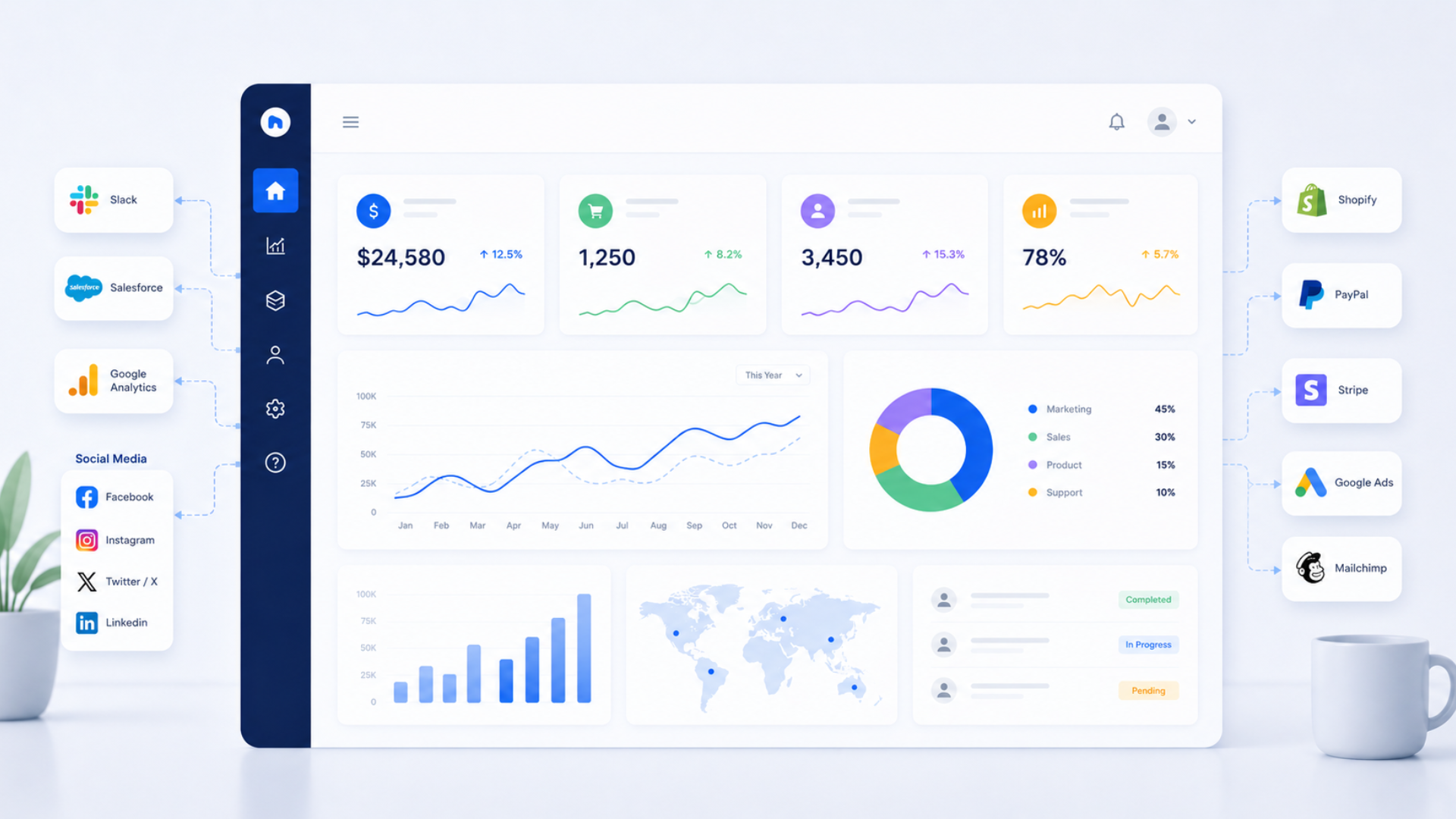
A unified dashboard is not simply a collection of widgets on a screen. It is a connected operational ecosystem. A well-integrated dashboard brings together the most important areas of the business into one centralized interface.
- Customer data.
- Sales pipelines.
- Marketing performance.
- Support activity.
- Financial insights.
- Project updates.
- Team productivity.
- Reporting and analytics.
The goal is not to overwhelm teams with information. The goal is to create visibility, accessibility, and alignment across the organization. A successful dashboard simplifies complexity instead of adding to it. It helps teams focus on action rather than administration.
Integration Is About Long-Term Growth
Many businesses treat integration as a technical upgrade. In reality, it is a strategic investment. The true value of integration is not just operational convenience. It is the ability to scale sustainably. Without connected systems, growth eventually creates operational pressure that slows progress. Teams become overwhelmed. Processes become fragmented. Decision-making becomes reactive.
A unified dashboard prevents this by creating structure around growth. It allows businesses to expand without losing visibility or control. That stability becomes increasingly valuable as operations grow more complex. Because scaling successfully is not about managing more chaos. It is about building systems that prevent chaos in the first place.
The Cost of Waiting
The longer businesses delay integration, the more expensive fragmentation becomes.
- Manual work increases.
- Data becomes inconsistent.
- Customer experiences become disconnected.
- Teams become less efficient.
- Decision-making slows down.
Eventually, businesses spend more time managing operations than driving growth. This is the hidden cost of disconnected systems. And unlike visible operational expenses, these losses compound quietly over time.
- Missed opportunities.
- Reduced productivity.
- Slower response times.
- Weaker collaboration.
- Lower customer satisfaction.
All of these issues become barriers to scaling.
Moving Toward Smarter Growth
The solution is not adding more tools. It is creating better connections between the tools you already use. Businesses do not scale successfully because they operate faster individually. They scale because their systems work together efficiently.
- Integration creates that efficiency.
- It transforms scattered processes into connected workflows.
- It transforms isolated data into actionable insights.
- And it transforms operational complexity into manageable growth.
In a business environment where speed, clarity, and adaptability matter more than ever, unified systems are no longer optional. They are essential.
Wrapping It Up
Scaling a business becomes difficult when systems stop communicating. Disconnected tools create delays, confusion, inefficiency, and fragmented customer experiences that quietly limit growth. What initially feels manageable eventually becomes operational chaos as the business expands. This is why integration matters. A unified dashboard does more than organize information. It creates visibility, alignment, automation, and operational clarity across the entire business.
Instead of working through disconnected processes, teams operate from a centralized system where information flows seamlessly and decisions happen faster. The businesses that scale successfully are not necessarily the ones with the most tools. They are the ones with the most connected systems. Because in the end, sustainable growth is not built on complexity. It is built on clarity, coordination, and integration.